
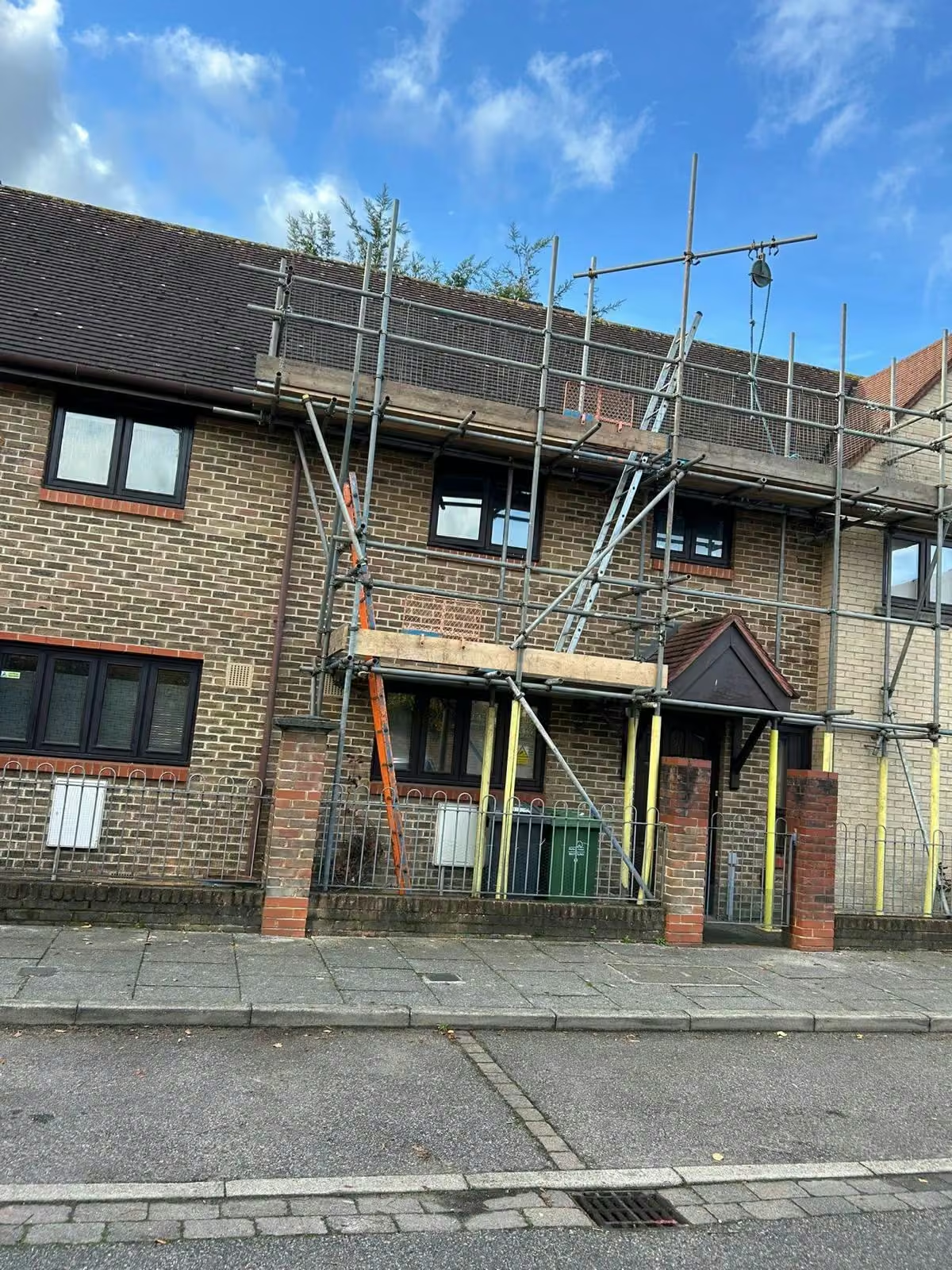
Short answer: you need your neighbour's permission to put scaffolding on their land or to have it overhang their property. In most cases a friendly conversation and a short written agreement is all it takes.
This is general information, not legal advice. For disputes or party wall matters, speak to a party wall surveyor or a solicitor.
When it comes up
On terraces and semis, it's common for a scaffold to need to cross the boundary. For example, a chimney on a shared stack, a gable wall built right on the boundary, or a rear extension with no room on your side. Even a scaffold that stands on your land but overhangs next door's garden or roof needs their agreement.
How to ask
- Talk to them early, before the job is booked if possible.
- Explain what the work is, how long the scaffold will be up, and exactly where it will stand.
- Offer to have the scaffolder show them the plan. We're happy to talk neighbours through it at the survey.
- Put it in writing (see below).
What to agree in writing
- Where the scaffold will stand or overhang, ideally with a sketch
- Start and end dates, and what happens if the job overruns
- Access arrangements, such as gates, side passages and times
- How their property will be protected, and photos of its condition before work starts
- Who to contact if there's a problem
If the work falls under the Party Wall Act
If your building work affects a party wall, a boundary wall or excavations near next door, the Party Wall etc. Act 1996 may apply. It gives you rights to access your neighbour's land for that work, with proper notice, and party wall surveyors usually agree the details. Scaffold access is often written into a party wall award. A party wall surveyor can tell you if the Act applies.
If your neighbour says no
First, ask what's worrying them. Often it's security, damage or how long it will be up, and a written agreement can sort that out. Sometimes we can redesign the scaffold to stay on your side, for example by using a cantilever or bridging. If the work is basic preservation of your property and there's no other way, the Access to Neighbouring Land Act 1992 lets you apply to court for an access order. That's a last resort, and you should get legal advice first.
How we help
At the free site survey we'll tell you whether the scaffold needs to cross the boundary at all, and look for a design that avoids it if we can. If it does, we'll explain the layout to your neighbour and build with care for both properties. See residential scaffolding.
Quick answers
Can scaffolding overhang my neighbour's garden without permission?
No. Overhanging their land or airspace without permission is a trespass. Get their agreement first.
Can you design the scaffold so it doesn't go on next door's land?
Often, yes. Bridging, cantilevers and careful positioning can keep everything on your side. We'll look at options at the survey.
Written by the Total Scaffolding Solutions team, CISRS-qualified scaffolders based in Wallington. Last reviewed October 2026.